How certificate and CAA monitoring works
Reviewed by Monitor360 MS Blog editor on
We use AI to help build Monitor360 and to draft some of our writing, including this post. It never decides whether a certificate passes or fails. How we use AI
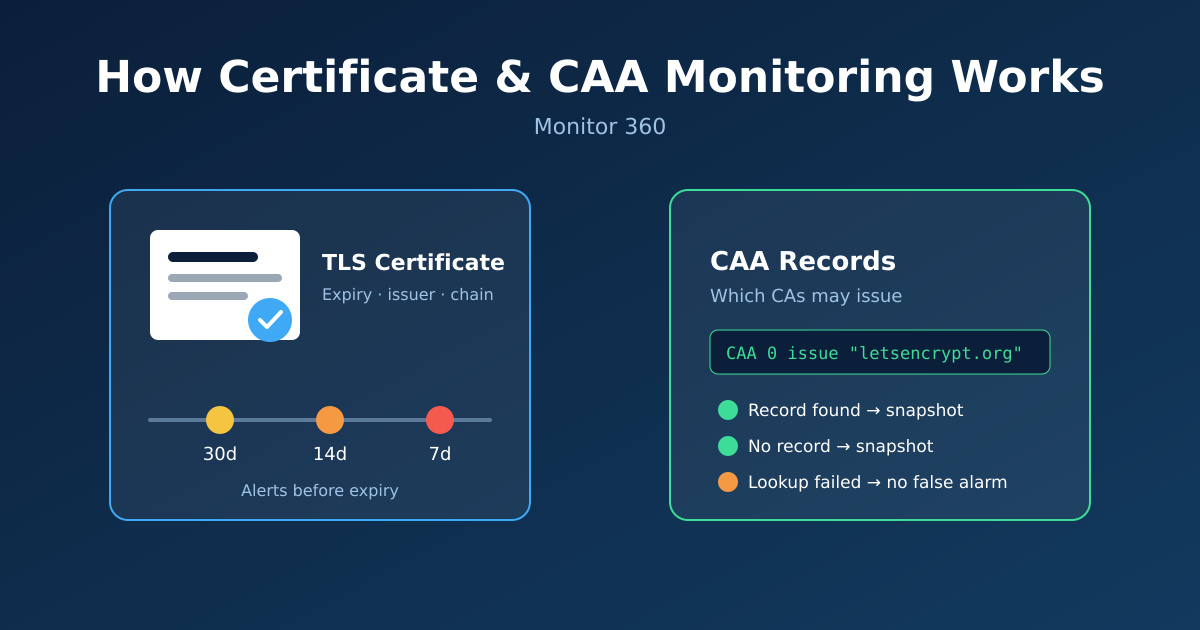 There are two separate things here, and it helps to keep them apart.
TLS certificate monitors
A TLS certificate monitor connects to a host and looks at the certificate it presents. It warns ahead of expiry, at 30, 14 and 7 days, and it notices when the issuer or the chain changes. It runs like any other monitor, on your plan's schedule.
Certificate verification: CAA records
A CAA record in DNS says which certificate authorities are allowed to issue certificates for a name. Monitor 360's certificate verification looks at those records for domains you add and raises findings you can acknowledge or suppress.
Some honest limits on how that works:
- Domains are claimed, not proven. Adding a domain does not verify that you own it.
- "Registrable domain" is a syntax check. It does not consult the Public Suffix List, so a name like
co.ukwould be accepted. - You can declare your intent. You can record which authorities you expect to issue for a domain, and a change to the records is raised as a finding.
A failed lookup is not an absent record
A DNS query can come back with a record, with a definitive answer that there is none, or fail (a timeout, a server error). Those are three different outcomes and we keep them apart.
Only the first two produce a snapshot or touch your findings. A failed lookup is not recorded as "no CAA record": treating a timeout as absence would raise a false "CAA is missing" finding and would also auto-resolve every open CAA finding on that name. A name that keeps failing eventually raises its own "unresolvable" finding, but only while a control query against a known-good name is still succeeding, so that a problem with our own DNS egress does not accuse every customer at once.
DNSSEC
Where we show DNSSEC information, it is the resolver's authenticated-data (AD) flag, relayed as the resolver reported it. We have not validated the chain ourselves, so we do not describe it as proof that anything is secure.
What is not delivered yet
At the time of writing, certificate verification findings (the CAA findings above) are visible in the product but are not sent by email or webhook. Alerts from TLS certificate monitors, such as the expiry warnings, do go to your configured alert contacts.